
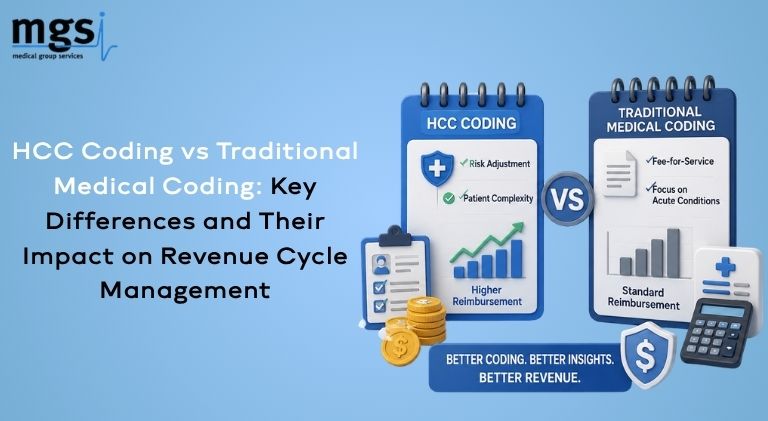
Medical coding plays an important role in ensuring that service providers are paid correctly for the services rendered. It is not true that all medical coding is done using the same coding process. With the advancement of value-based healthcare, HCC Coding has become quite important alongside Traditional Medical Coding.
Although both coding methods use ICD-10 diagnosis codes, they serve different purposes and directly influence reimbursement, compliance, quality reporting, and overall Revenue Cycle Management (RCM).
Understanding the differences between HCC Coding vs Traditional Medical Coding helps healthcare providers improve documentation, reduce claim denials, enhance risk adjustment accuracy, and maximize reimbursements.
At MGSI, our accredited medical coders assist healthcare providers with precise coding, risk adjustment, and Revenue Cycle Management solutions that enhance financial efficiency without compromising regulatory compliance.
What Is Traditional Medical Coding?
The concept of Traditional Medical Coding refers to the translation of a physician’s information into standardized codes used to bill healthcare providers.
The codes used include:
- Diagnosis codes ICD-10-CM
- Procedure codes CPT
- HCPCS Level II Codes
The codes are transmitted to insurance companies to determine payment for the service rendered.
Coding used in the traditional way ensures:
- Fee-for-service (FFS) payment
- Medical necessity
- Claims processing
- Accurate payment
- Compliance
The main objective of coding is ensuring proper reimbursement.
What Is HCC Coding?
Hierarchical Condition Category Coding is a risk adjustment prototype designed by the Centers for Medicare & Medicaid Services (CMS).
Unlike traditional coding, HCC Coding focuses on documenting chronic conditions and disease severity to predict future healthcare costs.
HCC Coding is widely used in:
- Medicare Advantage (Part C)
- Accountable Care Organizations (ACOs)
- Value-Based Care programs
- Risk Adjustment Payment Models
Rather than reimbursing providers solely for services performed, HCC Coding adjusts payments based on patient health complexity.
Accurate HCC Coding guarantees accurate reimbursement for the complexity of care provided to patients.
HCC Coding vs Traditional Medical Coding: Key Differences
1 Primary Purpose
Traditional Medical Coding is designed for claim submission and reimbursement for services provided during a
patient visit.
HCC Coding, on the other hand, measures patient risk by capturing chronic conditions that influence future
healthcare costs.
2 Payment Model
Traditional coding supports Fee-for-Service reimbursement, in which providers are paid for individual
procedures.
HCC Coding supports Value-Based Care, in which reimbursement reflects patients’ health risk and expected
care costs.
3 Diagnosis Reporting
Traditional coding reports diagnoses relevant to the current encounter.
HCC Coding requires providers to document all active chronic conditions that affect patient care during the
calendar year.
Incomplete documentation may reduce Risk Adjustment Factor (RAF) scores and lower reimbursement.
4 Documentation Requirements
Both coding methods require detailed documentation.
However, HCC Coding demands more comprehensive clinical documentation that clearly demonstrates:
• Diagnosis
• Assessment
• Monitoring
• Evaluation
• Treatment
This ensures chronic conditions are accurately captured for risk adjustment.
5 Impact on Revenue
Traditional coding affects payment for individual services.
HCC Coding impacts overall annual reimbursement by accurately representing patient complexity.
Missing chronic conditions can significantly reduce revenue under risk-based payment models.
6 Importance of Compliance
Coding is aimed at ensuring accurate coding and medical necessity.
HCC Coding also involves:
• Accurate risk adjustment
• Proper annual coding
• CMS compliance
• Audit-readiness
How HCC Coding Impacts Revenue Cycle Management:
Revenue Cycle Management extends beyond claim submission. Accurate coding influences every stage of the reimbursement process.
Enhanced Risk Adjustment Accuracy
- Correct HCC Coding allows providers to get paid based on the actual risk profile of their patients.
- Better documentation will lead to accurate RAF scores and prevent underpayments.
Fewer Claim Rejections
- Incorrect diagnosis documentation may cause coding inconsistencies and require payer review of claims.
- Coding professionals ensure that documentation confirms every diagnosis.
Improved Financial Planning
- Correct HCC Coding will help organizations predict their earnings based on their patients’ risk profiles.
- This is beneficial for long-term planning.
Stronger Compliance
- CMS continues increasing audits related to Risk Adjustment Data Validation (RADV).
- Accurate coding and documentation reduce audit risks while protecting organizational revenue.
Higher Provider Productivity
Outsourcing coding allows physicians to spend more time caring for patients while certified coding specialists manage documentation review and coding accuracy.
Common HCC Coding Challenges
Many healthcare organizations struggle with:
- Incomplete Clinical Documentation
- Providers may document symptoms but fail to document chronic conditions that qualify for HCC reporting.
Missed Chronic Conditions
Conditions such as:
- Diabetes with complications
- Chronic Kidney Disease
- COPD
- Heart Failure
- Depression
must be documented annually if actively managed.
Missing these diagnoses reduces reimbursement.
Coding Based on History Instead of Current Status
- HCC Coding requires documentation of current active conditions.
- Historical diagnoses without ongoing assessment should not be reported.
Annual Recapture Requirements
Unlike many traditional diagnosis codes, HCC diagnoses must generally be documented and reported each calendar year to maintain accurate risk adjustment.
Benefits of Professional HCC Coding Services
Collaborating with experts in coding brings many benefits.
Professional HCC Coding services benefit organizations by:
- Improving RAF score accuracy
- Identifying chronic illnesses accurately
- Avoiding coding mistakes
- Improving clinical documentation
- Maximizing reimbursement
- Ensuring CMS compliance
- Minimizing audit risks
- Improving Revenue Cycle Management
Why Choose MGSI for Medical Coding and Revenue Cycle Management?
Medical Group Specialized Integrators offers medical coding services that integrate industry knowledge, certified coding specialists who are certified, and technology.
We offer the following services:
- HCC Coding
- ICD-10 Medical Coding
- CPT Coding
- Risk Adjustment Coding
- Clinical Documentation Improvement (CDI)
- Medical Coding Audits
- Revenue Cycle Management
- Compliance Monitoring
- Denial Management
Our coding professionals stay up to date with CMS guidelines, ICD-10 revisions, and payer-specific requirements to ensure coding accuracy and maximize reimbursements.
Whether your organization operates under Fee-for-Service or Value-Based Care, MGSI delivers scalable coding solutions designed to improve financial performance and regulatory compliance.
Best Practices for Accurate HCC Coding:
Healthcare facilities can improve their coding efficiency through the adoption of the following best practices:
- Coding of all active chronic diseases at least one time per year.
- Verification of provider documentation for all the diagnoses reported.
- Periodic audits of the coding process.
- Education of physicians on HCC coding requirements.
- Checking the RAF score and coding trends.
- Utilizing certified coders.
- Utilizing CDI programs.
- Working with an expert medical coding company such as MGSI.
Conclusion:
Both HCC Coding and Traditional Medical Coding are essential components of modern healthcare reimbursement, but they serve different purposes.
Traditional Medical Coding will ensure that the provider is compensated for the care he or she has provided, whereas HCC Coding will help capture patients’ health complexity to enable value-based payments.
Those organizations that focus on proper coding, thorough documentation, and effective Revenue Cycle Management will be in a much better position in terms of reducing claim denials and being compliant as well as generating profits in the future.
If you choose MGSI to be your coding and RCM partner, you will benefit from coding expertise, cutting-edge technology, and tailored solutions.
Frequently Asked Questions (FAQs)
1 What is the difference between HCC Coding and Traditional Medical Coding?
Traditional Medical Coding is used to report diagnoses and procedures for claim reimbursement, while HCC
Coding focuses on documenting chronic conditions to determine patient risk scores and value-based
reimbursement.
2 Why is HCC Coding important in healthcare?
HCC Coding ensures providers receive appropriate reimbursement based on the complexity of patients’ health
conditions. It also supports risk adjustment, quality reporting, and CMS compliance.
3 Does HCC Coding use ICD-10 codes?
Yes. HCC Coding relies on ICD-10-CM diagnosis codes, but only specific diagnoses map to Hierarchical
Condition Categories recognized by CMS for risk adjustment.
4 How can an experienced medical coding firm enhance Revenue Cycle Management?
An experienced medical coding company can enhance Revenue Cycle Management in the following ways: greater
coding accuracy, improved clinical documentation, fewer claim rejections, improved compliance, higher
reimbursements, and stronger financial performance.
5 Are complex anesthesia claims delaying your reimbursements?
Our Anesthesia Medical Billing services help improve coding accuracy, reduce denials, and speed up payments.